If carpal tunnel syndrome needs to be operated on, local anaesthesia can be used for the short procedure. The WALANT method allows the procedure to be performed without a tourniquet - and significantly reduces stress and strain for the patient!
Carpal tunnel syndrome can rob you of sleep: the tingling in the fingers, which often occurs at night, wakes you up again and again... Later, pain is added, the fingers are numb and dexterity decreases. This is when you should see a neurologist at the latest and, if necessary, consider an operation - otherwise permanent and irreversible nerve damage can occur.
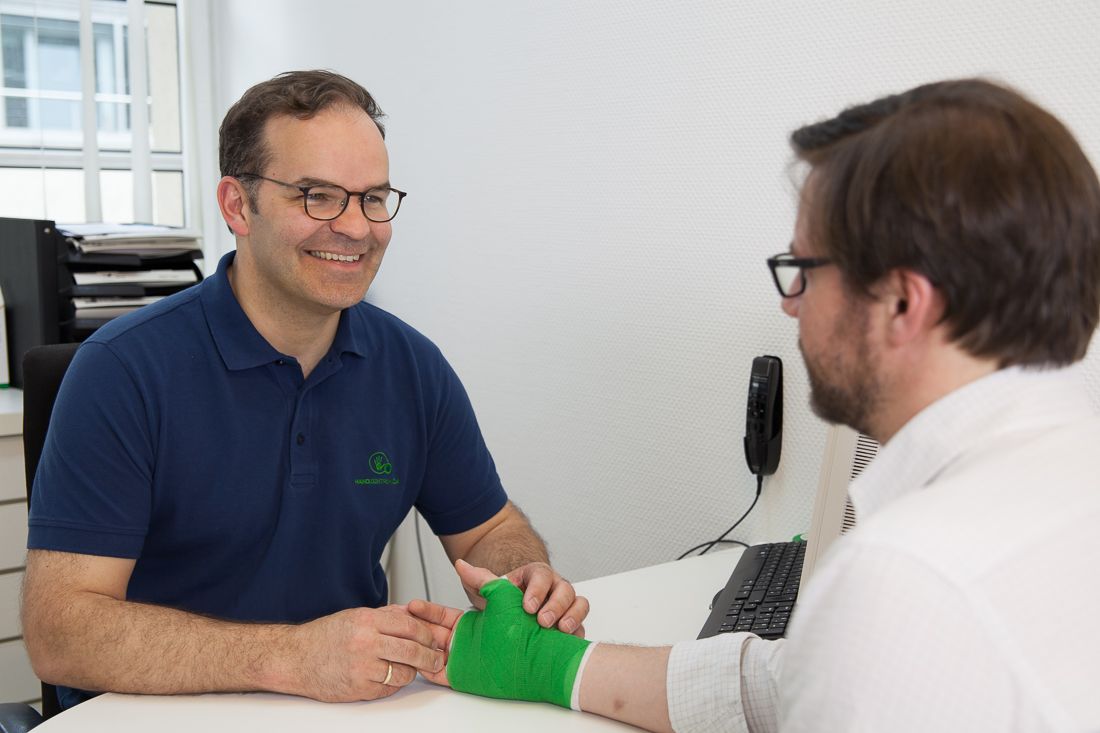
The median nerve of the arm (nervus medianus) is constricted, which is compressed at the level of the wrist in carpal tunnel syndrome. If conservative treatment attempts (e.g. by applying a splint to the wrist at night) no longer help, surgical treatment is often unavoidable in order to avoid permanent nerve damage. The carpal tunnel is then widened via a small incision in the palm of the hand and the pressure on the nerve is removed. This short but truly relieving operation can be performed under local anaesthetic, as it only takes around 10 minutes. The advantages for the patient are obvious: patients are awake and relaxed during the operation and can even talk to the operating theatre staff if they wish. Fasting is not necessary for the operation and the risks and side effects of a general anaesthetic or complete arm anaesthesia are eliminated. And best of all, patients can get up immediately after the operation and leave the practice after a short follow-up period walking upright. The entire procedure is therefore hardly more time-consuming than dental treatment.
The only disadvantage of local anaesthesia was the tourniquet that was previously required: In order to have a good view of all the important structures, a blood pressure cuff was inflated strongly on the arm and the blood supply to the arm was interrupted. This less pleasant part of the operation is no longer necessary with the "WALANT" method, which has been used successfully at the HANDZENTRUM KÖLN for years. WALANT stands for Wide Awake Local Anesthesia No Tourniquet. Adrenaline is added to the local anaesthetic so that the surgeon can see all important structures despite the free blood supply to the arm, thereby drastically reducing local bleeding. By eliminating the pressure on the arm, patients have a significantly more relaxed procedure. If necessary, the hand can even be moved during the procedure to check its function, and mobilisation of the fingers can begin immediately after the operation, thus shortening the rehabilitation period after the procedure.
The WALANT technique is also used for many other procedures - however, it should only be performed by surgeons who have extensive knowledge and experience in hand surgery and the use of local anaesthesia on the hand. At the HANDZENTRUM KÖLN, almost all surgeons have been awarded the "Expert Certificate in Hand Surgery" by the German Society for Hand Surgery and have the necessary many years of experience. Ultimately, it is not only the patients who benefit from the WALANT method - but also the surgeons: "There is no pressure on the upper arm and therefore no time pressure when operating under local anaesthetic - the patients are much more relaxed and so am I!" says Dr. v. Maydell, Medical Director of the Hand Centre.
Source:
Article by Dr Bernd von Maydell Carpal tunnel syndrome surgery under local anaesthetic at the HANDZENTRUM KÖLN stress-free thanks to the WALANT method - Orthopress | Das neue Onlineportal rund um ihre Gesundheit (dp-verlag.de)